
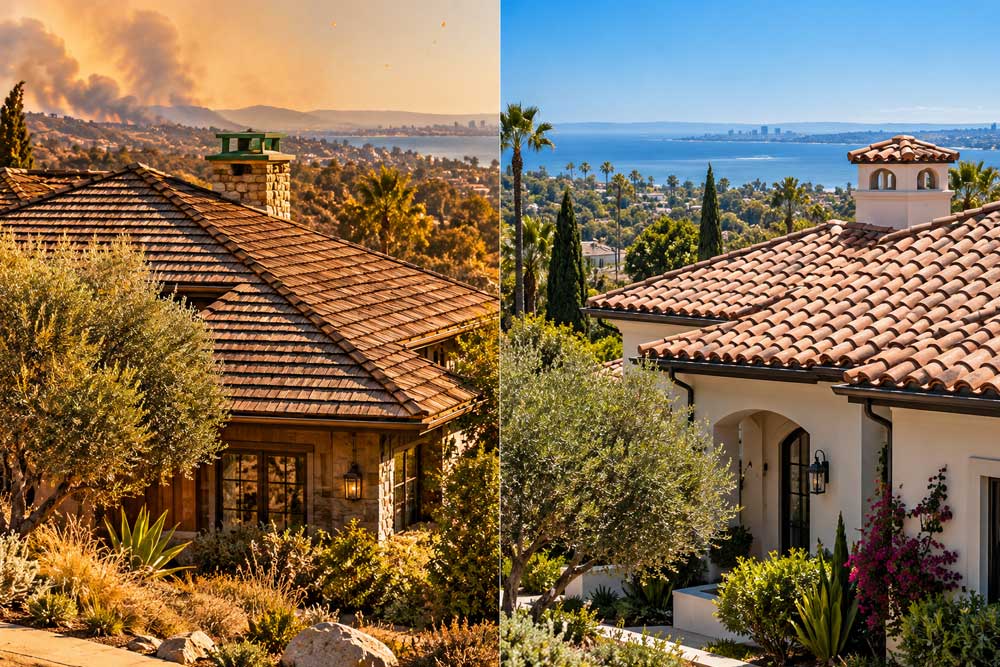
Choosing a roof in San Diego involves more than selecting a material that looks good from the street. Homeowners also need to consider wildfire exposure, structural weight, maintenance, energy performance, durability, and current roofing requirements. That is why the wood tile vs. concrete tile decision deserves a careful look at the entire roof system rather than appearance alone.
When people say “wood tile,” they are usually referring to wood shakes or wood shingles. These materials are known for their natural texture and traditional character. Concrete tile is manufactured in a wide range of profiles and colors, including products that imitate wood, slate, clay, and other premium materials. For many local homeowners, wood tile vs. concrete tile becomes a balance between preserving architectural character and meeting modern performance and fire-safety expectations. For older Spanish-style homes, see our Spanish clay tile roof restoration service.
What Is the Difference Between Wood Tile and Concrete Tile?
Wood shakes and shingles are made from natural wood. Shingles tend to have a more uniform appearance, while shakes often have a thicker, more rustic texture. Concrete tiles are manufactured from cementitious materials and can be shaped into flat, low-profile, barrel, S-shaped, slate-inspired, or wood-look designs.
The main distinction in wood tile vs. concrete tile is not only the material itself. Wood changes naturally with age and exposure, while concrete tile is designed to maintain a more consistent profile and appearance. Concrete can also be produced in many colors, allowing homeowners to match Spanish, Mediterranean, Craftsman, contemporary, and other architectural styles found throughout San Diego.
Why Does Fire Safety Matter in San Diego?
Wildfire and ember exposure are important roofing considerations across Southern California. Roofs have large exposed surfaces, and wind-driven embers can land in valleys, collect near roof-to-wall intersections, or enter vulnerable openings. A roofing material should therefore be evaluated as part of a complete assembly that includes underlayment, flashing, ventilation, decking, edge details, and maintenance.
Fire safety makes wood tile vs. concrete tile especially important for homes near canyons, brush, hillsides, and designated fire hazard areas. Current City of San Diego reroofing requirements call for Class A roof coverings for replacement, alteration, and repair work. California fire-safety guidance also emphasizes Class A roofing as part of home hardening. When repairs stop making sense, see how roof replacement in San Diego works with Pioneer Roofing.
For homeowners comparing wood tile vs. concrete tile, the key point is that the fire classification applies to the tested roof covering or assembly. Product selection and installation details both matter. For that reason, wood tile vs. concrete tile must be considered through both a design and fire-resistance lens.
Can You Replace a Wood Shake Roof With New Wood in San Diego?
For most standard reroofing projects within the City of San Diego, homeowners should not assume that an existing wood shake or wood shingle roof can simply be replaced with the same material. The City’s current reroofing bulletin states that renewals using wood shingles or wood shakes are not permitted except under limited historical-building provisions. It also states that new roof coverings cannot be installed over existing wood shakes or wood shingles.
This changes the practical wood tile vs. concrete tile comparison. A homeowner may prefer the appearance of cedar, but a replacement project must still satisfy current local requirements. Historic properties can involve separate rules and review procedures, so those homes should be evaluated individually.
Before selecting materials, homeowners can review current requirements through the City of San Diego and discuss the property with a qualified roofer.
How Does Concrete Tile Address Fire Safety?
Concrete tile is commonly used in Class A roof systems, making it a strong option when fire resistance is a major concern. However, homeowners should not assume that every installation is automatically equivalent. The tile, underlayment, roof deck, fastening method, slope, and other components must work together as the approved system.
In the wood tile vs. concrete tile discussion, concrete tile generally provides a more direct path toward the type of fire-resistant assembly now expected for reroofing in San Diego. Proper detailing is still essential because embers can collect around valleys, eaves, vents, penetrations, and roof-to-wall intersections.
That is why wood tile vs. concrete tile should never be reduced to “combustible versus noncombustible.” Fire performance depends on the complete roof, including how gaps and openings are handled. In practical terms, wood tile vs. concrete tile is as much about installation details as the visible surface.
Which Material Offers Better Curb Appeal?
Wood roofing has a natural warmth that many homeowners appreciate. Its grain, texture, shadow lines, and gradual weathering can complement Craftsman, cottage, coastal, and traditional homes. Concrete tile offers more consistency and a much broader selection of shapes and finishes.
A modern wood tile vs. concrete tile comparison also needs to account for wood-look concrete products. Some concrete tiles use textured surfaces, varied edges, and blended colors to create a shake-inspired appearance. They will not look exactly like natural cedar at close range, but they can preserve much of the visual character homeowners want.
For Mediterranean or Spanish-style homes, curved concrete tile may be a natural match. For modern architecture, flatter profiles can create a clean appearance. When evaluating wood tile vs. concrete tile, it is smart to look at full-roof examples rather than choosing from a small sample. The visual flexibility of modern products makes wood tile vs. concrete tile a much broader design choice than it was years ago.
What About the Weight of Concrete Tile?
Weight is one of the most important technical differences in wood tile vs. concrete tile. Concrete tile is considerably heavier than many wood shake, wood shingle, and asphalt roofing systems. An older home that was framed for a lighter roof may need structural review before a heavier tile system can be installed.
The City of San Diego’s current reroofing bulletin states that when existing wood shakes, wood shingles, or asphalt shingles are removed and replaced with roofing weighing more than six pounds per square foot, structural framing plans and calculations are required to verify the roof framing system.
This does not mean concrete tile is unsuitable. It means the wood tile vs. concrete tile decision should include the structure beneath the roof. A professional evaluation can determine whether the framing is adequate, reinforcement is needed, or a lighter alternative is more appropriate. Structural review is therefore a core part of wood tile vs. concrete tile planning on many older homes.
Which Option Is More Durable?
Durability depends on material quality, installation, climate exposure, maintenance, roof traffic, and the condition of the underlying assembly. Concrete tile itself can be very durable, but individual tiles may crack if they are struck or walked on improperly. The underlayment beneath the tile also plays an important role in long-term waterproofing.
Wood roofing can split, curl, weather, decay, or develop biological growth depending on moisture, age, and exposure. These differences make maintenance a major part of the wood tile vs. concrete tile comparison.
For many homeowners, concrete tile is attractive because of its long-term stability and resistance to sunlight and weathering. Still, no roofing system is maintenance-free. In a wood tile vs. concrete tile decision, the best choice is the one that fits the building and can be properly maintained over time. Maintenance expectations should always be included when comparing wood tile vs. concrete tile for long-term ownership.
How Do These Roofs Perform in San Diego’s Climate?
San Diego’s climate is mild compared with many parts of the country, but roofing materials still experience intense ultraviolet exposure, warm roof-surface temperatures, seasonal rain, wind, and coastal moisture in some neighborhoods. Conditions can also vary significantly between coastal communities, inland valleys, elevated areas, and canyon-adjacent homes.
In wood tile vs. concrete tile, wood naturally changes as it ages under sun and moisture. Concrete tile generally keeps a more stable physical profile, although color and finish may change gradually over time.
The visible material is only part of the equation. Drainage, flashing, ventilation, underlayment, attic insulation, roof slope, and workmanship have major effects on performance. A high-quality material installed over a poorly designed assembly will still create problems. Local exposure conditions can meaningfully influence the wood tile vs. concrete tile decision.
Which Is Better for Energy Efficiency?
Energy efficiency cannot be decided from wood tile vs. concrete tile alone. A roof works as a system, and thermal performance depends on insulation, air sealing, ventilation, tile profile, roof color, solar reflectance, underlayment, attic conditions, and HVAC efficiency.
Concrete tile can be incorporated into an energy-conscious roof design when the materials and assembly are selected together. Depending on the profile and installation method, there may also be an air space beneath portions of the tile that affects heat transfer. The exact impact depends on the full roof configuration.
At Pioneer Roofing, we use thermal scanners to identify temperature differences that may point to insulation or heat-transfer issues. Drone inspections allow us to document difficult-to-access areas, while digital measurements and AI-assisted analysis help improve project planning and material calculations.
This technology makes the wood tile vs. concrete tile conversation more useful because it allows decisions to be based on actual roof conditions. In suitable projects, Pioneer Roofing’s energy-focused approach can contribute to future heating and cooling cost savings of up to 30%. Actual savings vary depending on the home, insulation, HVAC system, materials, roof design, and energy use. A data-informed wood tile vs. concrete tile evaluation can reveal opportunities that a surface-only inspection may miss.
Can Concrete Tile Look Like Wood?
Yes. One reason the wood tile vs. concrete tile choice has changed is the variety of concrete products now available. Some are designed with rough textures, irregular edges, blended tones, and dimensional profiles intended to resemble wood shakes.
Concrete will not reproduce every detail of natural cedar, but homeowners may be able to maintain a warm, traditional appearance without using a conventional wood shake roof. This can be particularly useful when the architectural style calls for texture but current fire-safety requirements limit the practical use of wood.
When considering wood tile vs. concrete tile, homeowners should compare the appearance in direct sunlight, shade, and from normal street-viewing distances. Roof pitch and surrounding exterior finishes can dramatically affect how the finished material looks. For appearance-conscious homeowners, wood tile vs. concrete tile can still deliver several viable architectural directions.
What Maintenance Does Each Roof Need?
Routine maintenance matters regardless of the material. For concrete tile roofs, homeowners should periodically look for cracked or slipped tiles, debris in valleys, flashing problems, damaged penetrations, and signs of underlayment deterioration. Unnecessary foot traffic should also be avoided because walking incorrectly on tile can cause damage.
Useful maintenance steps include:
- Keeping valleys, gutters, and drainage paths clear.
- Checking for cracked, broken, or displaced tiles.
- Inspecting flashing around vents, walls, chimneys, and skylights.
- Watching for stains or other signs of water intrusion.
- Keeping combustible debris from accumulating on or around the roof.
- Scheduling inspections after major weather events or rooftop work.
Older wood roofs need additional attention to splitting, curling, deterioration, and fire vulnerability. In the wood tile vs. concrete tile comparison, long-term maintenance should be considered along with the initial installation.
How Do Costs Compare?
The true cost of wood tile vs. concrete tile is not simply the price of the visible material. Reroofing can also involve tear-off, disposal, roof deck repair, structural engineering, reinforcement, underlayment, flashing, ventilation upgrades, permits, solar-panel removal and reinstallation, and other project-specific work.
Concrete tile may require additional structural evaluation because of its weight. At the same time, a roofing system that better aligns with long-term fire-safety, maintenance, durability, and energy goals may provide value beyond the initial construction cost.
Pioneer Roofing uses digital measurements, drone inspections, thermal information, and AI-assisted analysis to reduce guesswork during planning. In a wood tile vs. concrete tile project, better information can help identify conditions earlier and improve material and labor planning. Looking at lifetime requirements makes wood tile vs. concrete tile more meaningful than comparing upfront material prices alone.
What If Your Home Already Has a Wood Shake Roof?
If your home currently has wood shakes, the first step should be inspection rather than immediately choosing a replacement material. The roof deck, framing, attic, drainage, underlayment, penetrations, and architectural characteristics should all be reviewed.
For many homes, the wood tile vs. concrete tile decision becomes a question of how to preserve the character of the property while transitioning to a roof assembly that fits current requirements. A shake-style concrete tile may be one possibility if the structure can support it.
Older properties may also raise historic-review questions. Because of that, wood tile vs. concrete tile should be evaluated before demolition or material ordering begins.
Does Concrete Tile Make a Home Wildfire-Proof?
No roofing material makes a home wildfire-proof. A Class A roof can significantly improve fire resistance, but embers can still collect in valleys, enter vulnerable vents, ignite debris, or reach combustible materials next to the roof.
This is another reason wood tile vs. concrete tile should be viewed as part of a broader home-hardening strategy. Proper flashing, protected openings, clean gutters, maintained vegetation, and attention to roof-to-wall intersections all matter.
A well-designed concrete tile system can improve the roof’s resistance to fire exposure, but installation details and maintenance remain essential throughout the life of the roof.
What Should You Ask Before Choosing a Roofing Material?
Before making a wood tile vs. concrete tile decision, ask questions that address the whole property rather than just the appearance of the roofing sample:
- Can the existing framing support the proposed roof?
- Will structural calculations or reinforcement be required?
- What Class A roof assembly is being proposed?
- What underlayment will be installed?
- How will valleys, vents, eaves, and penetrations be protected?
- Are there fire hazard or historic-resource considerations?
- What profile best matches the home’s architecture?
- Can the roof design improve thermal performance?
- What maintenance will the system require?
These questions make wood tile vs. concrete tile a building-performance decision rather than a purely cosmetic one.
Which Option Makes More Sense for a San Diego Home?
Wood tile vs. concrete tile is ultimately a property-specific decision.
For many current San Diego reroofing projects, traditional wood shake or wood shingle replacement is restricted, while Class A roof requirements are central to the project. Concrete tile can offer a practical alternative with a wide selection of architectural styles and fire-resistant roof assemblies.
However, the answer to wood tile vs. concrete tile is not automatically “concrete” for every property. Roof weight, framing, slope, architecture, underlayment, drainage, energy goals, budget, and permitting requirements must all be considered.
The best wood tile vs. concrete tile decision starts with a professional inspection. Understanding the structure and current roof condition first helps prevent homeowners from choosing a material that later creates structural, permitting, or performance problems.
How We Can Help
Pioneer Roofing is a family-owned San Diego roofing company that combines experienced craftsmanship with an innovative approach to inspection, design, and installation. When you are deciding between wood tile vs. concrete tile, we use tools such as thermal scanners, drones, digital measurements, and AI-assisted analysis to understand your roof in greater detail, improve project efficiency, reduce unnecessary construction costs, and identify opportunities for better energy performance. Depending on the property and the improvements made to the complete roof system, our energy-focused approach can contribute to future heating and cooling cost savings of up to 30%, although actual results vary. We can help you evaluate fire safety, structural capacity, aesthetics, energy efficiency, and long-term maintenance so your new roof is designed to fit both your home and the way you want it to perform.