
Last updated: November 2026
Tile roof repair is mostly about what sits under the tiles. Cracked and slipped tiles are the part you can see. On a clay or concrete tile roof, leaks usually come from worn underlayment or failed flashing, so a good repair checks those layers before it replaces a single tile.
If you’re here because of a broken tile, a crooked row or a ceiling stain after a storm, that paragraph is the short answer. The rest walks through the layers we check once the tiles come up on a San Diego clay or concrete tile roof.
What is under a tile roof?
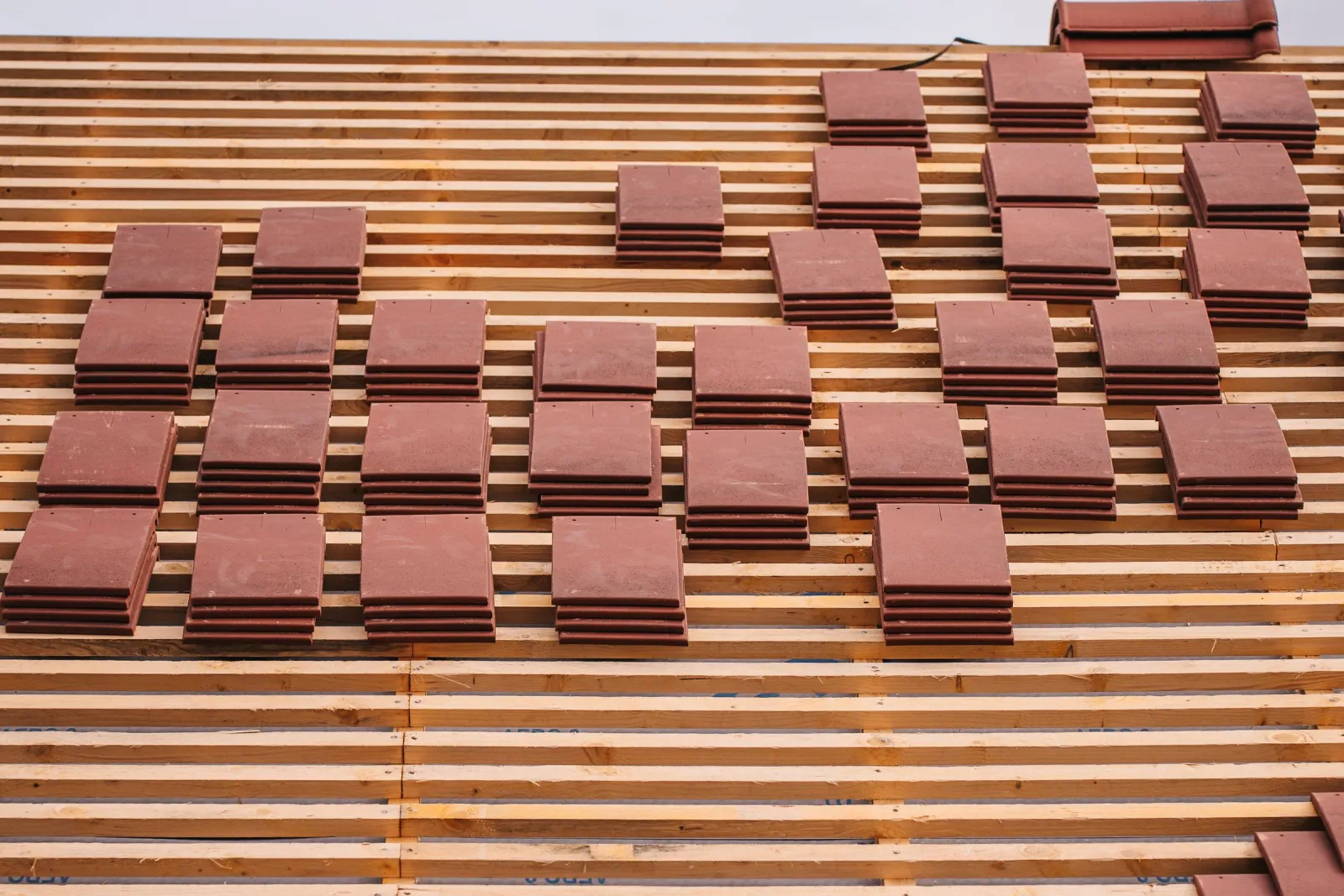
A tile roof is a stack of layers. The clay or concrete tile sits on wood battens, the battens sit on the underlayment, and the underlayment covers the roof deck, with metal flashing at the valleys, walls and chimneys. The Tile Roofing Institute calls the finished roof “a highly effective water shedding assembly,” which only works when every layer does its job.
Underlayment is the sheet material laid over the roof deck before any tile goes on. The Tile Roofing Institute’s installation manual for moderate climates (2010 edition, written with the Western States Roofing Contractors Association) says it “shall completely cover the decking and be lapped over hips and ridges and through valleys.” On our roof repair page, we put it this way: “the layer that actually keeps water out is the underlayment beneath them, and San Diego sun wears it down.”
Battens are the wood strips the tiles hang on. The same manual defines a batten as “a sawed strip of wood installed horizontally and parallel to the eave line,” there “to engage the anchor lugs to prevent slippage of the roof tile.” When a whole row starts to drift downhill, what holds the tile is worth a look. Our guide to fixing sagging roof tiles goes deeper on that.
A bird stop is the metal piece along the eave that lifts the first row of tile and closes the gap under it. Eagle Roofing’s product page describes it as “code approved 26 gauge Galvanized or Aluminum metal that prevents intrusion under the tile by birds or other wildlife.” It also “provides proper rise for the eave course, or first row of tile.”
Flashing is the metal that seals the joints where the roof meets something else. Under the 2025 California Residential Code, section R905.3.9, valley flashing on a tile roof must extend at least 11 inches from the centerline each way and have a splash diverter rib at least 1 inch high.
Under everything is the deck. Section R905.3.1 of the same code says clay and concrete tile “shall be installed over wood structural panels or solid lumber sheathing,” with an exception for spaced lumber sheathing in Seismic Design Categories A, B and C.
Why do tile roofs leak when the tiles look fine?
A tile roof can leak with every tile in place because the tile is not the layer that stops the water. As our repair page says, “tile roof leaks usually come from the underlayment or the flashing, not the tile you can see.” When the underlayment wears thin or a flashing joint opens up, water gets to the deck while the roof still looks fine from the street.
Replacing a cracked tile does not always stop a drip, because the torn underlayment below it is still torn.
Flashing is the other common culprit. One customer described a leak on a “Spanish style clay roof tile” roof that another company had tried and failed to fix. Our crew “repaired the flashing in three sections of the roof including a chimney.”
Slipped tiles still matter. The gap leaves the underlayment open to the sun and rain the tile was shielding it from.
If a stain shows up after the first storm of the season, note where it sits. A stain below a chimney, a skylight or the line of a valley points to flashing. A stain in the middle of a plain slope points more toward the underlayment in that area. Neither is proof. It just tells the roofer where to start lifting tiles.
How do you tell cracked tiles from failed underlayment?
From the ground you usually can’t tell for sure, and climbing up to check is a bad idea. Cracked or slipped tiles are often visible from the yard. Failed underlayment is hidden under the tile and shows up indirectly, as a ceiling stain, damp attic wood, or a leak that comes back after a tile was replaced.
Please stay off the roof. Tile is easy to break underfoot. The Tile Roofing Institute’s manual tells trained installers that “pressure should only be applied on the headlap of the tile units (lower 3-4 inches).” A homeowner who steps in the wrong place can turn one cracked tile into five, on top of the fall risk.
What you can do safely is look. From the ground, check for tiles sitting out of line with their row, pieces of tile in the gutter or on the walkway, and gaps where you can see the dark underlayment. Inside, a flashlight in the attic after rain can show stains or damp spots on the underside of the deck. Photos of both help whoever comes out.
When we inspect, we use drone imaging, and thermal scanning where it helps, so we can see the whole roof without walking all of it. Then we lift tiles in the suspect area and look at the underlayment and flashing directly. One customer’s review of a concrete tile job noted that “Photos were taken to show damaged and repaired areas, and a drone was used at the beginning and end of the job.” Our roof inspection checklist lists what a full inspection should cover.
What does a tile roof repair involve, step by step?
A proper tile roof repair opens up the damaged area, fixes the layer that failed and puts the tile back so it sheds water again. On a typical leak, we work in this order.
- We find the entry point. That means checking the roof with drone imaging, thermal scanning where it helps, and matching what we see to the stain or damp spot inside.
- We lift the tiles around the problem area and set them aside so they can go back where they came from.
- We check what is underneath. Most of the diagnosis happens here: torn or brittle underlayment, open flashing at a valley, chimney, wall or vent, or soft wood in the deck.
- We repair the layer that failed. Depending on what we find, that can be new underlayment in that section, repaired flashing, or new decking where the wood is damaged.
- We put the tile back. In the words of our repair page, “We reset slipped tiles, replace cracked ones and repair flashing.” Broken tiles get replaced with matching tile.
- We check the repair before we leave. Our tile repair page says, “We verify that the roof is sealed, secure, and performing efficiently using post-repair thermal scans.” The same page says our inspections “document everything for transparency.”
Step 3 is the one that changes the price and the plan, so it should be done before anyone quotes you a number for a full job. You can see what is included on our tile repair service page.
Damage under the tile is not always water damage. On one Carmel Valley re-roof, the customer wrote that “We had quite a bit of termite damage that was identified and quoted in the initial estimate, and for the most part there were no surprises.” Another wrote that “The crew worked really efficiently to install plywood under our roof and replace our roof tiles.”
Can broken tiles be matched on older San Diego homes?
Often, yes, though an exact match depends on whether the original tile is still made in that profile and color. When it isn’t, the usual options are reusing existing tile from the same roof and finishing new tiles to blend in. Our service page says: “We match existing tiles, repair underlayment.”
One customer with an older concrete tile roof wrote: “My 40 yr. old original concrete tile roof was replaced, re-using the tiles along with several ‘new’ tiles that were painted to match the existing tiles.”
A lift and relay is a re-roof where the existing tiles come off, the underlayment and other layers below them are replaced, and the same tiles go back on. On that Carmel Valley job, the customer wrote: “We opted for a lift and relay of existing tile in order to save a a little money on our job.” Whether it makes sense depends on how many tiles are still sound once they come off.
Clay barrel tile on Spanish-style homes brings its own color and shape questions. Our page on Spanish clay tile roof restoration covers that work.
When is a tile repair not enough?
A repair is the right call when the damage is limited to one area, such as a valley, a chimney or a few tiles, and the underlayment outside that area is still sound. Replacement makes more sense when the damage spreads across slopes, the underlayment is worn across large sections, or leaks keep coming back after proper repairs.
That is the rule on our roof repair page, which puts the second half bluntly: “If the underlayment is worn out across a big section, a patch won’t hold, and we’ll say so.”
A lift and relay sits between the two. It replaces the underlayment across the roof while keeping the tile you already have. On a roof with sound tile and tired underlayment, it is worth asking about.
Frequently asked questions
Can I walk on my tile roof to check for damage?
No, it’s better not to. Clay and concrete tile can crack under a person’s weight, and a fall from a roof is a serious risk. Even trained installers are told by the Tile Roofing Institute’s manual to put pressure only on the headlap, the lower 3 to 4 inches of each tile. Look from the ground and in the attic instead, take photos, and let a roofer with a drone or proper footing check the rest.
Is a slipped roof tile an emergency?
A single slipped tile is not usually an emergency, but it shouldn’t wait for months either. The gap leaves the underlayment below open to sun and rain, and Pioneer Roofing Company’s repair page notes that San Diego sun wears underlayment down. If water is already coming inside, call a roofer right away. If not, have the tile reset before the next storm.
What roof pitch does a clay or concrete tile roof need?
Under the 2025 California Residential Code, section R905.3.2, clay and concrete roof tile must be installed on roof slopes of 2 1/2 units vertical in 12 units horizontal or steeper. Flatter sections of a roof need a different roofing material. If part of your home has a low-slope section next to a tile roof, the joint between the two is a spot worth checking.
What is the difference between a tile repair and a lift and relay?
A tile repair fixes one area: a valley, a chimney, a few cracked or slipped tiles and the underlayment directly below them. A lift and relay takes the tile off the whole roof, replaces the underlayment and other worn layers, then reinstalls the same tile. A repair suits damage limited to one spot. A lift and relay suits sound tile sitting on worn underlayment across large sections.
How we can help
Pioneer Roofing Company repairs clay and concrete tile roofs across San Diego County, on homes, HOAs and commercial buildings. We inspect first, with drone imaging and thermal scanning where they help, then lift the tile to find the real entry point. You get a written quote that says whether we recommend repair or replacement, and why.
We’re a family business, licensed in California (C-39 Roofing, License #1060507) and insured. If you’ve spotted cracked or slipped tiles or a new stain after the rain, call 619-432-7663 or request a free quote. Se habla español.